Learn tax strategies for high net worth clients.
Enrolled Agent Approved

Learn tax strategies for high net worth clients.
Enrolled Agent Approved
What is a penalty and what do you do when the IRS asserts a penalty?
Enrolled Agent Approved
How to deal with an IRS audit. Discussion Leader: Bill Strickland
True financial planning is a collaborative process between a client and advisor that encompasses all aspects of an individual’s financial life. However, what does the financial planning process look like and what should the approach be? By examining academic theory and illustrative case examples, this course will explore how financial planning changes over a client’s lifetime. We will discuss common investor types and approaches to financial planning, including traditional and reverse glidepath theory. Discussion Leader: David Peters
How debt is allocated to the partners in a partnership is important. It dictates how much money may be taken tax-free as a distribution, the losses that flow down to the partners, and the gain or loss on the sale of a partnership interest. However, the allocation of debt can differ depending on the type of debt that it is and the type of partner we are talking about. Not to mention that 704(c) can complicate things. And what in the world is a constructive liquidation scenario? In this session of Understanding Partnership Taxation, we will tackle the concept of debt allocations – how you do it, what it means, and why you do it! Discussion Leader: David Peters
Cash flow management is often the most important task of any CFO or financial leader. Regardless of whether one works in start-ups or established companies, non-profit or for-profit entities, cash flow makes our organizations run. Have you ever wondered whether you are optimizing your company’s cash flow? In this course, we will explore how to improve your company’s cash flow using analysis and financial theories in the context of real-world situations. Discussion Leader: David Peters
Navigating the complexities of small business partnerships requires a keen understanding of the financial dynamics at play. Small business owners often blur the lines between personal and company finances, leading to frequent distributions from these partnerships. As advisors, it’s crucial for us to comprehend the tax implications of these distributions, distinguishing which ones are safe and which might pose a problem. In our comprehensive course, we delve into partnership basis calculation, a critical yet often confusing aspect of our practice. We explore the distinctions between inside basis, outside basis, and 704(b) basis, shedding light on this intricate topic through easy-to-follow examples and practice problems. Additionally, we will discuss the different types of distributions-cash, property, and hybrid-providing clarity on scenarios where a mix of both cash and property is involved. Lastly, we will examine the tax implications of initial contributions of property to a partnership, ensuring a well-rounded understanding of partnership dynamics. Discussion Leader: David Peters
How do you determine who is an employee and who can be treated as an independent contractor? Discussion Leader: Bill Strickland
What you should know about preparing Forms 990 Discussion Leader: Bill Strickland
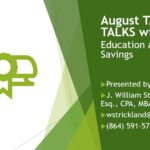
What to know about 529 plans. Discussion Leader Bill Strickland
Privacy Policy | Terms of Use | CPE Policies
© Copyright 2024 South Carolina Association of CPAs | All Rights Reserved